
|
|
||||||||||||||||

ABOUT THE FILM:

Girl Crazy is one of the most celebrated of all the Gershwin musicals. Since its debut on Broadway in 1930, the show has had several film and stage adaptations.
The original stage production opened on October 14, 1930, starring Ginger Rogers and Ethel Merman in her Broadway debut. Merman introduced the song "I Got Rhythm," stopping the show with every performance. Red Nichols' pit band for the show is just as famous, including such future musical greats as Glenn Miller, Jimmy Dorsey, Benny Goodman, Gene Krupa, Jack Teagarden, and future MGM music arranger/associate producer (and Judy's mentor) Roger Edens.
RKO Studios produced a film version in 1932, adapting the story to fit the talents of the comedy team (Bert) Wheeler and (Robert) Woolsey and retaining only "But Not For Me," "Bidin' My Time," and "I Got Rhythm." A new Gershwin song "You've Got What Gets Me" was included, and is included (along with several tracks from the 1943 version) on the 1997 2-CD set "George & Ira Gershwin In Hollywood."
This 1943 version is by far the best of the film versions, and in my opinion it's the best of the Mickey/Judy "Let's Put On A Show" musicals. It's also the last. Mickey and Judy would not appear together on film again until Judy's short guest spot 1948's Words And Music performing a duet of "I Wish I Were In Love Again."
Girl Crazy is bit notorious in the "Garland Legend." It's on the set of this film that Judy's health issues from overwork and medications began to cause real, and public, problems. This is famously portrayed in the 2001 ABC-TV miniseries "Life With Judy Garland." The miniseries shows Judy gobbling pills to keep her going under the harassing (to say the least) direction of Busby Berkeley while shooting the "I Got Rhythm" number. Judy (expertly portrayed by Tammy Blanchard) collapses and passes out.
Berkeley did in fact wear everyone to a frazzle when filming "I Got Rhythm" while taking the film $60,000 over budget! It was the first sequence to be filmed, and as musical arranger Roger Edens later stated "We disagreed about the number's presentation. I wanted it rhythmic and simply stage, but Berkeley got his big ensembles and trick cameras into it again, plus a lot of girls in Western outfits with fringe skirts and people cracking whips, firing guns and cannons going off all over my arrangement and Judy's voice. Well, we shouted at each other, and I said, 'There isn't room on the lot for both of us.'"
Hedda Hopper visited the set at one point, and reported: "I saw [Berkeley] work her over. He watched from the floor with a wild gleam in his eye while take after take he drove her to the perfection he demanded. She was close to hysteria; I was ready to scream myself. But the order was repeated again and again: 'Cut. Let's try it again Judy. Come on, move! Get the lead out.'"
Berkeley was fired from the film, replaced by Norman Taurog with Charles Walters handling the musical numbers. On January 29, just a few days after Berkeley's firing, Judy was confined to her bed and ordered by her family physician Marcus Rabwin to not dance for six to eight weeks. True to Garland form, she quickly got better and was back on the set in just a few weeks, at which time she did double duty on Girl Crazy and the new replacement finale for Presenting Lily Mars.
Even though Judy was better, she was still fragile. She would miss many more days due to illness. Location shooting in Palm Springs (including parts of the delightful "Could You Use Me?" number) was cursed by sand storms and equipment failures, as well as a brief absence by Judy when she rushed back to Los Angeles for a romantic tryst (presumably with Joe Mankiewicz).
In spite of all of these problems, the film turned out beautifully. Judy gives a wonderful performance as does Mickey. Her version of "But Not For Me" is one of the best numbers she ever did on film. To quote Clive Hirschhorn from his massive 1981 book "The Hollywood Musical:" "Gershwin never had it so good."
TIMELINE AT A GLANCE:
November 30, 1942: Pre production begins.
December 22, 1942: Judy took a break to record her solo guest spot in Thousands Cheer.
December 29, 1942: First recording session for "I Got Rhythm".
January 2, 1943: Recording session for "Bronco Busters" and "I Got Rhythm".
Early to mid January 1943: Filming of "I Got Rhythm".
January 26, 1943: Busby Berkeley is fired.
January 29, 1943: Judy is confined to bed rest for exhaustion caused by the "I Got Rhythm" number.
Early February 1943: Judy resumes filming Girl Crazy, with new director Norman Taurog.
February 22, 1943: Official announcement made that Judy and first husband David Rose had separated.
February 20 through March 16, 1943: Judy takes a break to rehearse, record and film the new finale for Presenting Lily Mars.
March 17, 1943: Judy resumes filming Girl Crazy.
March 29, 1943: Judy records "But Not For Me".
April 14, 1943: Judy records "Bidin' My Time".
April 15, 1943: Judy records "Embraceable You", and with Mickey records the ultimately deleted reprise of the song.
April 28, 1943: Judy and Mickey record "Could You Use Me?".
May 2, 1943: Judy leaves Los Angeles for Palm Springs location shooting.
May 11, 1943: Judy leave Palm Springs for her tryst in Los Angeles, but is back in Palm Springs a few days later.
May 19, 1943: Last day of filming.
June 9, 1943: Recording/post scoring session (Judy hummed her bit for the post-"Embraceable You" "Walking In The Garden" sequence, Roger Edens provided the whistling for Mickey's character).
CAST:
SONGS Treat Me Rough Bidin' My Time Could You Use Me? Embraceable You Fascinating Rhythm But Not for Me I Got Rhythm Outtakes: Bronco Busters Embraceable You (reprise finale) |
Mickey Rooney as Danny Churchill, Jr.
Judy Garland as Ginger Gray
Gil Stratton as Bud Livermore
Robert E. Strickland as Henry Lathrop
Rags Ragland as Rags
June Allyson as Specialty Number
Nancy Walker as Polly Williams
Guy Kibbee as Dean Phineas Armour
Frances Rafferty as Marjorie Tait
Henry O'Neill as Mr. Churchill, Sr.
Howard Freeman as Governor Tait
Tommy Dorsey and His Orchestra as Themselves
Sidney Miller as Ed
Eve Whitney as Brunette
Carole Gallagher as Blonde
Kay Williams as Blonde
Jess Lee Brooks as Buckets
Roger Moore as Cameraman
Charles Coleman as Maitre d'Hotel
Harry Depp as Nervous Man
Richard Kipling as Dignified Man
Henry Roquemore as Fat Man
Alphonse Martell as Waiter
Barbara Bedford as Churchill's Secretary
William Beaudine, Jr as Tom
Peter Lawford as student
Frances McInerney as Checkroom Girl
Sally Cairns as Checkroom Girl
Victor Potel as Stationmaster
Joe "Corky" Geil as Student
Ken Stewart as Student
Irving Bacon as Reception Clerk
George Offerman, Jras. Messenger
Mary Elliott as Southern Girl
Katharine Booth (aka Karin Booth) as Girl
Harry C. Bradley as Governor's Crony
Chief Many Treaties as Indian Chief
Rose Higgins as Indian Squaw
Spec O'Donnell as Fiddle Player
Sarah Edwards as Governor's Secretary
William Bishop as Radio Man
James Warren as Radio Man
Fred Beckner (aka Fred Coby) as Radio Man
Showgirls: Georgia Carroll, Aileen Haley, Noreen Nash, Natalie Draper, Hazel Brooks, Mary Jane French, Inez Cooper, Linda Deane
Boys: Don Taylor, Jimmy Butler, John Estes, Bob Lowell Committee Women: Blanche Rose, Helen Dickson, Milissa Ten Eyck, Vangie Beilby, Julia Griffith, Lillian West, Sandra Morgan, Peggy Leon, Bess Flowers
Vocals provided by: The Music Maids, The Stafford Trio, The King's Men, Six Hits and a Miss

CREW:
Produced by: Arthur Freed
Directed by: Norman Taurog
Screen Play by: Fred F. Finklehoffe
Music by: George Gershwin
Lyrics by: Ira Gershwin
Based Upon Musical Play "Girl Crazy" by Guy Bolton and Jack McGowan
Musical Adaptation: Roger Edens
Musical Direction: Georgie Stoll
Orchestration: Conrad Salinger, Axel Stordahl, Sy Oliver
Vocal Arrangements: Hugh Martin, Ralph Blane
Dance Direction and Solo Dance with Miss Garland by: Charles Walters
"I Got Rhythm" Number directed by Busby Berkeley
Musical Presentation: Merrill Pye
Art Direction: Cedric Gibbons
Set Decorations: Edwin B. Willis
Associate: Mac Alper
Costume Supervision: Irene
Associate: Sharaff
Recording Director: Douglas Shearer
Directors of Photography: William Daniels, Robert Planck
Film Editor: Albert Akst
MEDIA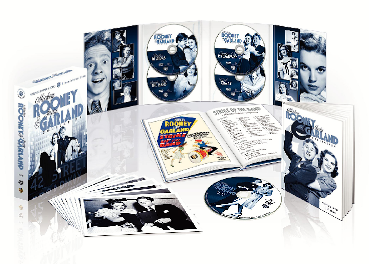
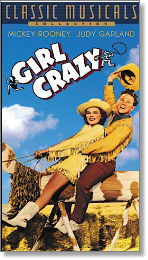
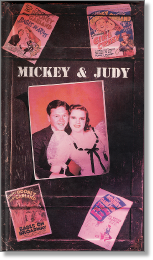
L-R top row: Two VHS editions; 4-CD Rhin0 Records Set; TCM Greatest Classic Legends DVD set.
L-R bottom row: Two "bootleg" records; Single CD edition of the restored soundtrack.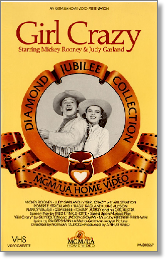




top of page
© The Judy Room - Site Updates - About

© The Judy Room and its outlets are provided for the advancement of knowledge about (and study of) Judy Garland's life and career.