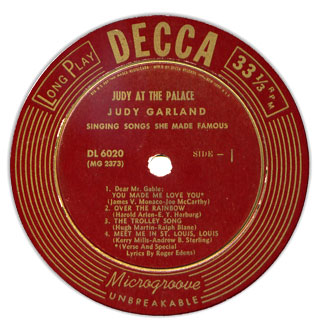
LINER
NOTES:
(As written by Louis Untermeyer for the 1951 Decca album).
About Judy Garland...
The place is the Palace on Broadway; the date is October 16,
1951. The theatre is filled to the last seat with an excited
and expectant audience...the footlights dim...the red velvet
curtain parts...and vaudeville comes back with a rush--with
Judy Garland.
The epitome of vaudeville, a complete show
all by herself, Judy projects the buoyant spirit of the "two-a-day" with
everything she has: bounding vitality, spirited gestures expressing
a
vibrant personality, and an extraordinarily flexible voice
which can move the heart with the whispered syllable of "Over
the Rainbow," clang its way through "The Trolley
Song," and
cry out the unashamed sentiment of "For Me and My Gal." This
is Judy,
the phenomenon, the sophisticated film star - but at the same
time the girl who can communicate genuine emotion with a delicate
quaver, follow it with comic pratfalls, and, distaining the
use of a microphone, send her vibrato straight up to the second
balcony. With this combination, her personality leaps, soars,
and sweeps across the footlights. It is little wonder that
she lifts the crowds clear out of their seats.
For once the critics and the audiences
were in complete and vociferous agreement. "The explosion
of applause which greeted Miss Garland," wrote Robert
Sylvester in the Daily
News, "got
completely out of hand. The enfant terrible of musical films
finally hollered it down herself, and then went on to do one
of the most fantastic one-hour solo performances in theatrical
history." "It was a spectacular night for the Palace
spinning back the clocks to 1933, when vaudeville 'died' more
or less
officially," said Ward Morehouse in the New York World-Telegram
and Sun. "And the night belonged to Judy Garland." "She
was the star of the recrudescence of the Palace," wrote
Jack Lait of The Mirror, "Leading it back toward
its splendor and glory as the cathedral of Broadway's cult,
show business."
All this was no more than one might
have expected, for Judy belongs to the top echelons of show
business. She was practically
born in the theatre. Her father ran a variety playhouse in
the little town of Grand Rapids, Minnesota, and Judy was three
years old when, as "Baby Frances Gumm," she made
her debut on his stage. A little later Judy and her two sisters
set out
on a vaudeville act, billed as "The Gumm Sisters." One
day Judy took matters into her own hands. As soon as her sisters
walked off the stage, she stayed on to sing by herself. The
song was "Jingle Bells" and she repeated it five
times. her natural gift for holding the center of the stage
never deserted her. From Minnesota the family moved to California,
where Judy attended school, became an active member of the
baseball and basketball teams, and continued to sing on any
stage that was handy. She won her first role with Deanna Durbin
in a short entitled "Every Sunday Afternoon." When "Broadway
Melody of 1938" came along, it established Judy as a young
singing star. Fame came to her easily. Her stature grew with
"Love Finds Andy Hardy" and rose to heights with her unforgettable
performance as Dorothy in "The Wizard of Oz." The latter
brought her the coveted Academy Award, and Judy accepted the
golden
statue from her most arden fan, Mickey Rooney. "For Me and
My Gal," "Girl Crazy," "Meet me in St. Louis," "The
Harvey Girls," and "Easter Parade," in which she was co-starred
with
Fred Astaire, are some of her more distinguished successes.
Her records sold in the millions. Her appearance at the London
Palladium was a record-breaking engagement.
Yet, through all of this, Judy retained
her amazing simplicity joined with an even more amazing versatility.
Wistfully plaintive or exuberantly gay, she has never lost
the breathlessly young quality which is characteristic of perennially
youthful vaudeville - - and Judy Garland.
About the Palace...
The Palace Theatre was built in the spring of 1913 and
became the pivotal point of the B.F. Keith circuit, which at its height booked
1,500 theatres and controlled some 20,000 performers throughout the country.
B.F. Keith and Edward Albee had become partners in the 1880's and they were responsible
for having introduced "refined" vaudeville to a public fed up with the common
variety entertainment. It grew to be the center of the "two-a-day" - which
was Broadway's way of indicating that there were two performances every day,
including
Sunday.
For 20 years the Palace was the home of all that was
best in vaudeville. It held its position as the show-place of the nation with
its assembly of the
country's greatest entertainers performing against a background tingling with
excitement. Then a combination of motion pictures and vaudeville was introduced.
This lasted only a few years, and by 1936 the Palace adopted a straight picture
policy. In 1949 the Palace again combined feature films and feature acts by live
actors. However, it was not until October 16, 1951 that the cycle completed itself
and the Palace returned to the two-a-day routine - with Judy Garland launching
the historic event.
CREDITS
Notes by Louis Untermeyer
|